




For calibrations, the most commonly used measuring points are pH 4.01, pH 7.01 and pH 10.01. The accuracy of the standard solutions is ±0.02 pH at 25 °C.
The pH meters can be calibrated with buffer solutions over the full pH range according to the application needs.
Our company manufactures and distributes a range of pH calibration solutions, which include standard, technical and thousandths accuracy solutions. This wide range has a variety of applications, which will be explained in more detail below.
Standard solutions
All of our calibration solutions are manufactured to industry standards and are available in a variety of pack sizes.
It is important to note that all solutions are certified, but not all of them come with a certificate to this effect, which can be ordered on request with the calibration solution.
If you need a measurement certificate, please contact us before you buy. We are also available to answer any questions you may have.


Technical calibration solutions
The technical calibration solutions have the accuracy of standard solutions and all of them are accompanied by a quality certificate. Technical solutions are available in a wider range, i.e. many more pH values, covering the entire pH range. This is important for multi-point calibration, which provides much higher accuracy.
In two-point or multi-point calibration, the operation is performed with more than one calibration point. If, for example, the pH value around which the expected measurement results will be obtained is known in a production or control process, then two-point calibration can be used to ensure even greater measurement accuracy. One point should be above the expected result and the other below.
What is the pH value ?
The pH expresses the chemistry of the solutions, which can be acidic, alkaline or neutral. The pH value refers to the activity of the hydrogen ion and is a dimensionless quantity, ranging from 0 to 14 pH. The pH value of pure water is 7 and is called neutral, less than pH<7 indicates acidity and greater than 7<pH indicates alkalinity.
Let's look at concrete examples. Lemon juice has a pH of between 2 and 3, soda water has a pH of around 2.5 and apple juice has a pH of around 3. So, if you want to know the exact pH of these examples, calibrate before measurement using technical solutions with a pH between 1.00 and 4.01. This will ensure that the measurement is as accurate as possible within the expected range for lemon juice, soda water and apple juice.
Why is calibration necessary?
Calibration ensures the accuracy and reliability of pH measurements, so it is recommended that you calibrate before taking measurements.
The operation of the pH electrode can be determined from the so-called slope and offset values (described by the Nernst equation).
It is important to stress that the characteristics of the electrode change over time.
Calibration also allows the condition of the electrode to be assessed, with slope and offset values providing feedback. The offset is the magnitude of the signal sent by the electrode at pH 7.01 in mV. The slope is the mV change per unit change in pH. If these values are significantly different from what is expected during calibration, it is very likely that the electrode is damaged, contaminated or simply too old and needs to be replaced.

Click
In reality, the actual behaviour of the electrode is not exactly the same as described by the Nernst equation. This is why calibration is necessary. Properly performed calibration can be used to correct for changes due to electrode ageing. During calibration, the slope and offset can be determined with a buffer solution of known value, and these are taken into account by the instrument algorithm.

Handling and storage of solutions
Proper handling and storage are important to ensure that the calibration solution retains its quality for as long as possible.
The solution can easily become contaminated, especially if the electrode is immersed directly into the bottle during calibration. Do NOT do this, as a contaminated solution will no longer allow accurate calibration, i.e. measurements will not be reliable.
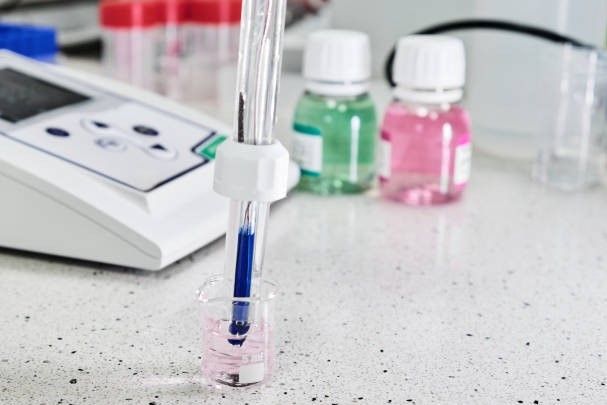
For calibration, always pour only the required amount into a measuring beaker that has been rinsed with deionised water.
It is also extremely important that the used solution is NOT poured back into the bottle, as this will also contaminate the contents of the bottle.
Although calibration as often as possible (even several times a day for continuous measurements) is recommended practice, we are aware that this is a time-consuming operation and may not be possible in a busy quality control laboratory, for example. If laboratory accuracy is not so important, calibration every week or fortnight is sufficient.
Never store pH or ORP electrodes in distilled or deionised water. This will shorten the life of the sensor.
The unopened solution can keep its quality for years. After opening, buffers below pH 7 can be used for up to 3 months, while solutions with pH 7 or higher can be used for up to 1 month.
How to store the electrode correctly
Preventing clogging of the permeable membrane (junction) and rapid response of the electrode can be ensured by proper storage. The sensing sphere must be kept clean and moist at all times. CLNE storage solution is an excellent solution for the correct storage of electrodes.
Put enough solution in the protective cap of the electrode to cover the conductor, then place the cap on the end of the electrode. In the absence of a storage solution, a calibration solution of pH 4,01 or 7,01 may be used. The electrode should not be stored in solutions above pH 7,01 or in distilled or deionised water!
Cleaning the electrode
The most common cause of inaccurate measurements is a contaminated or improperly cleaned electrode. It's important to remember that just because an electrode looks clean, it may still have dirt on it that is not visible to the eye. However, deposits on the sensor sphere can significantly affect calibration and measurement accuracy and stability.
The primary signs of electrode contamination may be fluctuating readings, calibration anomalies (i.e. not calibratable) or slow stabilisation of the measurement.
Check the condition of the electrode frequently. If there are scratches or cracks on the surface of the electrode (especially on the sensor sphere), the electrode should be replaced.
How to clean the electrode professionally
1. Rinse the electrode with deionised water
Before immersing the electrode in the calibration solution, rinse thoroughly with deionised water to avoid contamination of the calibration solution. The electrode should always be rinsed before immersion in any solution and after removal from the solution. Deionised water is recommended for rinsing the electrode, but distilled water or even tap water may be used.
2. Use fresh buffer solutions for calibration
Your calibration will be as accurate as the calibration buffer solutions you use. Solutions below pH7 should be used within 3 months of opening, solutions above pH7 will retain their quality for 1 month.
To avoid contamination of the solutions, the electrode should not be immersed directly into the bottle or the used solution poured back into the bottle. If the same solution is to be used for several calibrations, it is advisable to fill it into a sealable container. The solution in the container should be changed regularly, daily or weekly depending on the use. Solutions in pouches contain enough solution for one calibration and are ready to use, making them ideal for calibration in the field.
It is important to note that basic buffer solutions (i.e. those with pH 7.01 and above) are less stable than acidic solutions. This is due to atmospheric carbon dioxide diffusing into the solution. In the case of long standing, filled solutions, the actual value may be lower than the nominal value of the solution, resulting in inaccurate calibration (hence measurement).
3. Cleaning the electrode
To clean, immerse the tip of the electrode in CLNE's general cleaning solution for 15-30 minutes. Depending on the area of application of the electrode, the nature of the dirt and deposits can vary. To remove different types of contamination, a cleaning solution appropriate to the nature of the contamination should be used.
After the cleaning process, the electrode should be rinsed thoroughly with deionised water and soaked in CLNE storage solution for at least 2-3 hours prior to measurement. Then calibrate the electrode and start the measurement. For best results, the electrode can be left in the storage solution overnight.