




CLNE manufactures and distributes premium quality mg/l TDS calibration solutions, expressed in ppm, which are prepared to NIST traceable against solutions of the salts used.
CLNE solutions are clearly labelled with the batch number and expiry date, and the caps are hermetically sealed to ensure the quality of the solution.
The CLNE TDS calibration solutions are specifically designed to have an expiry date of 5 years from the date of manufacture for unopened bottles.
The CLNE standard TDS calibration solutions are most commonly used for calibration at 382 mg/l, 800 mg/l, 1500 mg/l, 6.44 g/l and 12.41 g/l, but of course other standard solutions can be used depending on the application. The measured value of the calibration standard solutions is highly temperature dependent, so it is important to always take the temperature into account when measuring.
What is TDS?
One of the quantities that can be derived from conductivity is the so-called total dissolved salinity, also known by the foreign abbreviation "Total Dissolved Solids". This actually refers to the amount of dissolved substances (both organic and inorganic) in the solution being tested. The unit of measurement is mg/l (ppm) or g/l (ppt).
The TDS measurement is essentially an indirect measurement, as the result is derived from the measured conductivity. For each solution, there is a so-called conversion factor, which is used to calculate the TDS from the measured EC. The factor can be determined from the known dissolved salinity of a substance. Let us take an example: for 56 g/l TDS, the conductivity is 800 mS/cm. Since 800*0,07=56, the factor is 0,07.
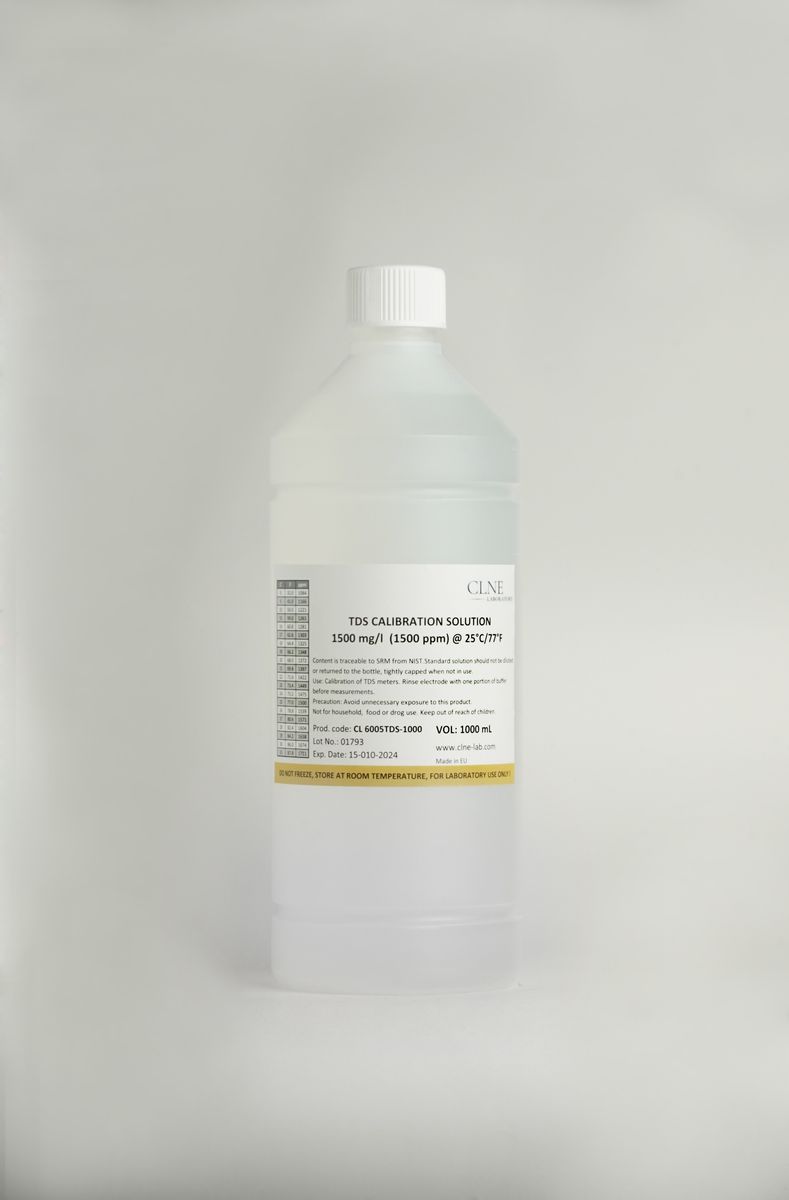
Proper storage of the TDS calibration solution
Proper handling and storage are important to ensure that the calibration solution retains its quality for as long as possible.
The solution can easily become contaminated, especially if the electrode is immersed directly into the bottle during calibration. Do NOT do this, as a contaminated solution will no longer allow accurate calibration, i.e. measurements will not be reliable. Always pour only the required amount of solution for calibration into a measuring beaker, which has been rinsed with deionised water. It is also extremely important that the solution used is NOT poured back into the bottle, as this will also contaminate the contents of the bottle.