




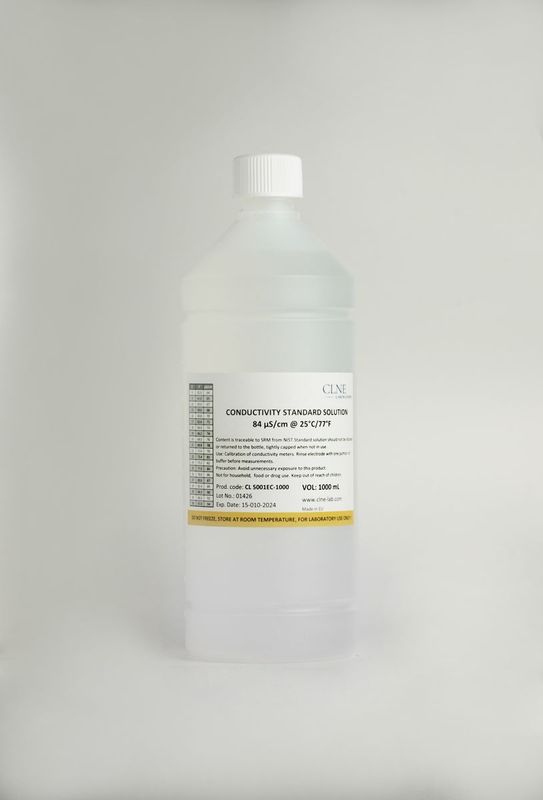
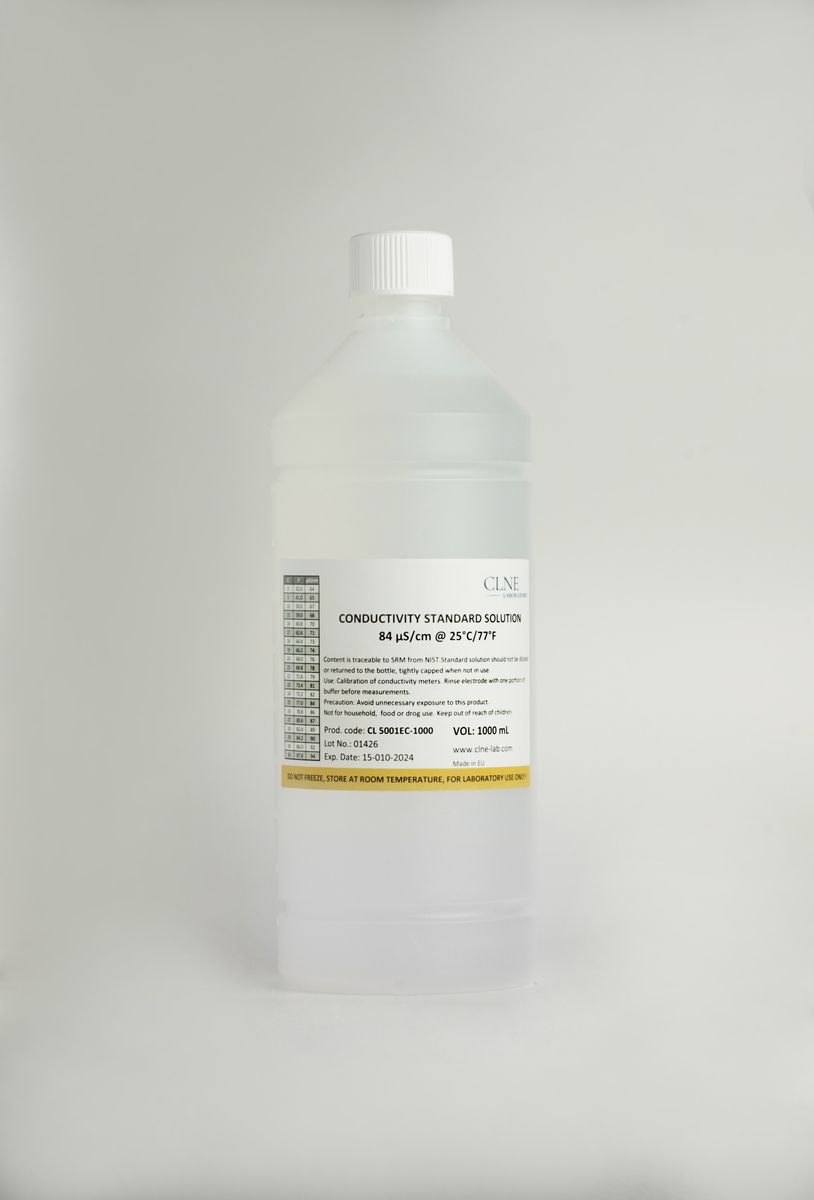
For the calibration of conductivity measuring instruments, the most commonly used measuring points are 84 µS/cm, 1413 µS/cm, 12 880 µS/cm and 80 000 µS/cm, but of course there can be different standard solutions depending on the application. The measuring value of calibrating standard solutions is highly temperature dependent, so it is important to always take the temperature into account when measuring.
All of our calibration solutions are manufactured to industry standards and are available in a variety of pack sizes. It is important to note that all solutions are certified, but not all of them come with a certificate to this effect, which can be ordered on request with the calibration solution. If a certificate is required, please contact us before purchasing. We are also available to answer any questions you may have.
CLNE's calibration solutions are premium quality specific conductivity solutions standardized with a conductivity meter and calibrated with NIST 2202 SRM (Standard Reference Material) potassium chloride in deionized water for analytical use according to ISO 3696/BS39786/BS39786. Additional equipment used to prepare the solutions includes certified weight-checked balances, Class A glass containers and certified thermometers.
What is electrical conductivity?
There are many names for it, such as electrical conductivity, electrolytic conductivity, EC (Electrical Conductivity) or "conductivity".
EC is a measure of conductivity measured over a given section. The unit of measurement is Siemens/cm (S/cm, mS/cm or µS/cm). The 'specific section' is also known as the cell constant, which is a specific characteristic parameter of the probe used to measure conductivity.
CLNE is a premium quality standard value of defined µS/cm conductivity, produced against a NIST traceable solution of potassium chloride. Solutions with CLNE conductivity are always labeled with the lot number and expiration date, and caps are hermetically sealed to ensure solution quality. The standard values for CLNE solutions are designed to provide an expiry date of 5 years from manufacture for an unopened bottle.
The temperature chart printed on the flasks shows the actual µS/cm at different temperatures.

Fundamentals of conductivity measurement
EC is essentially based on the measurement of concentration. It is important to note that it is not specifically designed to measure a particular concentration, as not all substances are capable of conducting current and therefore their quantity cannot be measured in this way. Only those substances in which ions are present have conductivity. Ions can carry positive or negative charges in a liquid. For example, dissolving sugar in water does not change the conductivity of the water very much. This is because sugar does not break down into ions that can carry charge.
Conductivity is directly related to the concentration of dissolved ionic substances.
Effect on temperature
Conductivity measurements are affected by temperature. This is because temperature affects the behaviour of ions. Higher
temperature, the activity of the ions increases, reducing resistance and increasing conductivity. At low temperatures, the activity of the ions decreases
energy, so the resistance increases and the conductivity decreases. This makes temperature compensation of measurements essential. This is done by
is ensured by a thermal sensor built into the probe, which allows compensation against a reference temperature.

Click
Proper storage of conductivity calibration solution
Proper handling and storage are important to ensure that the calibration solution retains its quality for as long as possible.
The solution can easily become contaminated, especially if the electrode is immersed directly into the bottle during calibration. Do NOT do this, as a contaminated solution will no longer allow accurate calibration, i.e. measurements will not be reliable. Always pour only the required amount of solution for calibration into a measuring beaker, which has been rinsed with deionised water. It is also extremely important that the solution used is NOT poured back into the bottle, as this will also contaminate the contents of the bottle.
Why is it important to know the conductivity of water?
Conductivity can be important for many industrial applications. Let's look at some examples. In pipelines, water heaters and boilers, large quantities of water flow through. There may be impurities in the water, which can cause problems in the operation of the water heaters if they settle out or protrude. During heating, the water turns to steam and the impurities remain. Over time, this can increase significantly, reducing the efficiency of the water heater.
Water skiing
During pre-treatment, incoming water testing can alert operators to changes in water mineral content, conductivity and pH to maintain efficient operation.The ion exchange resin is regenerated with an aqueous saline solution, the concentration of which is controlled by the system based on a wide range of conductivity measurements.
Surface management
There are a number of surface treatment processes, all of which involve rinsing during treatment to remove contamination from the metal surfaces to be treated. The contaminants washed off the metal surfaces also contaminate the water used for rinsing, rendering it unusable over time. To use water sparingly, it is advisable to measure the conductivity, as the EC can be used to estimate how contaminated the rinse water is.
Pharmaceutical industry
Conductivity also plays an important role in the production of pharmaceuticals, as it is a measurement used to control the quality of the water used to make medicines. Pharmaceutical companies have very strict quality requirements. By measuring conductivity and TOC, it is possible to ensure that water quality remains within regulatory limits.